Friday, January 29, 2010

A little history about North American small cars

There was a nice article in yesterday's Globe & Mail paper about the (mostly failed) attempt of U.S. automakers to enter the small car market in the early 1960's. [article link] A quote from an auto journalist at the time still rings true today; it's taken a recession and high gasoline prices to start to change buying habits, and only slightly.
"Personally I go along with the thinking that America is basically a big-car country with big-car needs. I feel that unless we have a depression of major size or 60 cents a gallon gasoline, the so-called big cars will still grab off 80 per cent of the market.”
-- Tom McCahill, Modern Mechanix (circa 1960)

Labels: ,


Friday, August 07, 2009

A tumultuous year: Small never looked so good!

Due to other ventures, this blog has languished to the bottom of my priority list. Perhaps it's fitting given the tumultuous year it has been in the auto business; just keeping up-to-date on the drama of the American Big Three (GM, Chrysler, Ford) would be a challenge, rendering some posts obsolete within days (case in point: the small Pontiac G3: discontinued shortly after being released). After all, this blog is not about mergers, buy-outs, bail-outs, bankruptcies or subsidies: it's about small cars.

Overall, the economic downturn has been good for "small", and not only for cars, but as a general philosophy of frugality, of living more simply. In the car sector, the recession has accomplished what $150 USD/barrel oil, and the resulting high gasoline prices, last year couldn't: people are now actually buying small cars in droves. In Canada, DesRosiers Automotive Consultants showed that by the end of 2008 the market share of sub-compact cars reached 8.7% (of total automobile sales), double the previous year's numbers. It's not a stretch to think that for 2009 the market share will be well into the teens. In the United States, the popular Cash-for-Clunkers program (which was just extended by the U.S. Senate yesterday evening) has propelled the small-ish Ford Focus to a top seller. In the U.K., which has their own scrappage program, it's a small car (the Ford Fiesta) leading the pack as the top car being chosen after trade-ins.

These are exciting times for small car enthusiasts. If this was 1969 again, Honda might have thought twice before dropping the idea of the selling the small 600 here in North America. This time around, I hope companies stop heeding the old stereotypes that imply that we need bulkier, faster, gas guzzlers just because we live on this side of of the world. Let's hope that we the consumers are the ones who are allowed to make a choice from the full spectrum of products, including the small cars available in the rest of the world.

Which ones am I anxiously waiting to test drive? The TH!NK city (a small electric car), the Fiat 500 (just awarded the title of "Best City Car" for 2009 in the U.K.) and the Toyota iQ (a tiny car that's much sexier than the Smart car). Hurry up and bring them over to this side of the Atlantic!

Labels: , ,


Wednesday, July 02, 2008

A warning to auto manufacturers that don't take small cars seriously!

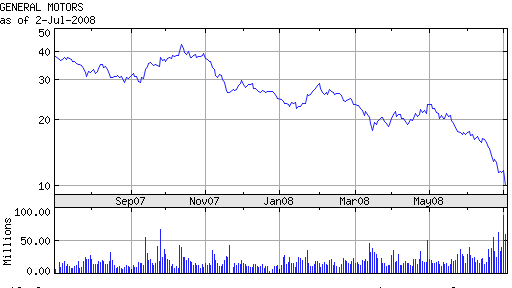
I don't mean to pick on GM when it is down (look at that very sad stock chart!), but their situation is so clearly small car related... In fact, I would not be surprised if the course of GM over the last few years becomes a classic case study for future business students.

So what has led to GM's stock price going to below $10, for the first time since the 1950's? They made mistakes on four fronts:
  1. Their fleet of vehicles was overly weighted on larger cars and trucks. In a world of increasing environmental awareness and rising oil prices, this lacked any foresight. They simply went with what worked for them in the past, what customers were demanding up to now...

  2. Not counting sports cars, nor cars like the Vibe, G5 or the Cobalt -- which GM classifies as "small" on its web site, but which are truly low end mid-size cars -- their only true small, fuel-efficient automobile for sale in North America was the hatchback Aveo5. It's a decent car, but the problem is that GM doesn't make any significant profit on it.

  3. GM's R&D division has churned out the Chevy Volt, a valiant attempt at a smallish, plug-in electric hybrid car. The problem is GM has been dragging it's feet at actually releasing it. Americans would not be able to buy it before 2010, at the earliest. Why has it taken so long? The business acumen of GM headquarters needs to be questioned when we consider that there was a 1998 prototype version of the EV1 (GM's previous electric car prototype from the early 1990's) with a hybrid motor configuration, that had four seats (unlike the first EV1, which only seated two), and the same all-electric range of 60 km as the Volt. In contrast to the current Volt, this car was actually a running prototype. Not to mention that the turbine could run on many fuels, from gasoline to compressed natural gas. 10 years onward and they're still at the prototype stage, possibly even one step behind where they were in 1998.

  4. GM's factories are not as flexible as those of some of its competitors (e.g., Toyota); they are extremely model-specific. So, even if GM had a larger offering of smaller cars, or if they decided to massively push the Aveos, it would take them over a year and hundreds of millions of dollars to retrofit existing plants.

For now, GM is burning through over a billion dollars a month. We'll see what the geniuses at the top come up with now. Bankruptcy is more than just "not impossible" (quoting Merrill Lynch analyst John Murphy in his statement today), in my opinion, it's getting increasingly likely every day. The best case scenario for them right now would be for a white knight firm to come buy them out and force their hand at making the tough, yet obvious, decision to "go small".

Labels: , ,


Tuesday, June 03, 2008

A sign of things to come?

GM just announced this morning that they will be closing 4 truck production plants, including the one in Oshawa, here in Canada. In addition, some SUV plants will also be shut down. Full details are available in the news release placed online just over an hour ago. Perhaps we could finally be seeing a peak in large vehicle sales in the U.S., eventually to be overtaken by smaller cars. Here in Canada, small cars already appear to be on track to passing larger vehicles (see related post here).

The news release also mentions that GM is definitely going ahead with their electric vehicle (the Volt), with a target of having it in showrooms in the United States by 2010.

Labels: ,