Wednesday, July 02, 2008

A warning to auto manufacturers that don't take small cars seriously!
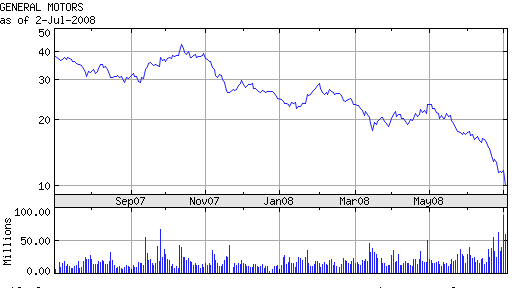
I don't mean to pick on GM when it is down (look at that very sad stock chart!), but their situation is so clearly small car related... In fact, I would not be surprised if the course of GM over the last few years becomes a classic case study for future business students.

So what has led to GM's stock price going to below $10, for the first time since the 1950's? They made mistakes on four fronts:
  1. Their fleet of vehicles was overly weighted on larger cars and trucks. In a world of increasing environmental awareness and rising oil prices, this lacked any foresight. They simply went with what worked for them in the past, what customers were demanding up to now...

  2. Not counting sports cars, nor cars like the Vibe, G5 or the Cobalt -- which GM classifies as "small" on its web site, but which are truly low end mid-size cars -- their only true small, fuel-efficient automobile for sale in North America was the hatchback Aveo5. It's a decent car, but the problem is that GM doesn't make any significant profit on it.

  3. GM's R&D division has churned out the Chevy Volt, a valiant attempt at a smallish, plug-in electric hybrid car. The problem is GM has been dragging it's feet at actually releasing it. Americans would not be able to buy it before 2010, at the earliest. Why has it taken so long? The business acumen of GM headquarters needs to be questioned when we consider that there was a 1998 prototype version of the EV1 (GM's previous electric car prototype from the early 1990's) with a hybrid motor configuration, that had four seats (unlike the first EV1, which only seated two), and the same all-electric range of 60 km as the Volt. In contrast to the current Volt, this car was actually a running prototype. Not to mention that the turbine could run on many fuels, from gasoline to compressed natural gas. 10 years onward and they're still at the prototype stage, possibly even one step behind where they were in 1998.

  4. GM's factories are not as flexible as those of some of its competitors (e.g., Toyota); they are extremely model-specific. So, even if GM had a larger offering of smaller cars, or if they decided to massively push the Aveos, it would take them over a year and hundreds of millions of dollars to retrofit existing plants.

For now, GM is burning through over a billion dollars a month. We'll see what the geniuses at the top come up with now. Bankruptcy is more than just "not impossible" (quoting Merrill Lynch analyst John Murphy in his statement today), in my opinion, it's getting increasingly likely every day. The best case scenario for them right now would be for a white knight firm to come buy them out and force their hand at making the tough, yet obvious, decision to "go small".

Labels: , ,


Monday, December 17, 2007

Fiat to go micro in 2009 and green by 2012

In an interview last week with Automotive News Europe, Fiat CEO Sergio Marchionne mentioned that the company is hoping to sell its first microcar by 2009. It's a "true beauty," said Marchionne. We can speculate that it might look quite a bit like the concept microcar that Fiat presented to the world in 2005, pictured here. Perhaps they can call it the "Piccolo" (italian for small), but more likely it will end up being a variation on the Panda, their current (slightly ugly) almost-micro car.

Fiat has been having great success with its updated version of the Fiat 500, the Fiat Nuova 500; it's selling very briskly in Europe and is garnering many awards, including the prestigious EuroCarBody 2007 and the European Car of the Year 2008. It would appear that this success is giving Fiat confidence to go even smaller... Roughly 30 centimeters smaller to be precise (to get into the microcar category).
In the same interview, Marchionne asserted that "Fiat will be the carmaker with the lowest average emissions in 2012," and that they "do not need hybrids to get there." To all the hybrid devotees out there (yes, it almost seems like a religion these days), this must sound scandalous. But it's actually quite simple; going with increasingly smaller cars is likely the way they are going to achieve this goal. Perhaps he was reading my post from March...

Labels: , , ,


Monday, March 12, 2007

Small is greener than hybrid

After electrics and hydrogen-powered, hybrids have the least emissions -- right? Not necessarily! The carbon dioxide rejection rate is roughly the same for a Toyota Prius (touted as the most efficient hybrid currently on the market) and a Citroen C1 (a smart-looking small car, sadly not available in North America) -- roughly around 100ish grams per kilometer. I'm sure that an even smaller car, such as a Smart car, would be even lower...

But that's just the start. One could then argue that the environmental footprint of the C1 is smaller than the hybrid Prius simply because it can be manufactured with less stuff; it is lighter, its engine is simpler, it is easier to recycle. Not to mention that its smaller physical size is good in other ways; it doesn't require as wide a road to operate, needs smaller parking spaces, etc. -- so it doesn't comtribute to the general encroachment of paved space into the world's green spaces.

I don't buy the way hybrids are presented as the responsible, green choice. It's good marketing for sure, but the truly environmentally responsible choice is to go small!

(Hints to Citroen: make a hybrid version of the C1, oh and don't forget to bring it over to the U.S. and Canada!)

Labels: ,


Friday, October 13, 2006

Obvio 828

There's small, and then there is tiny! What's not OBVIOus about this brazilian car on first glance is that it's actually a "tribrid" -- a normal gas/electric hybrid, but it also runs on ethanol.

Labels: ,